
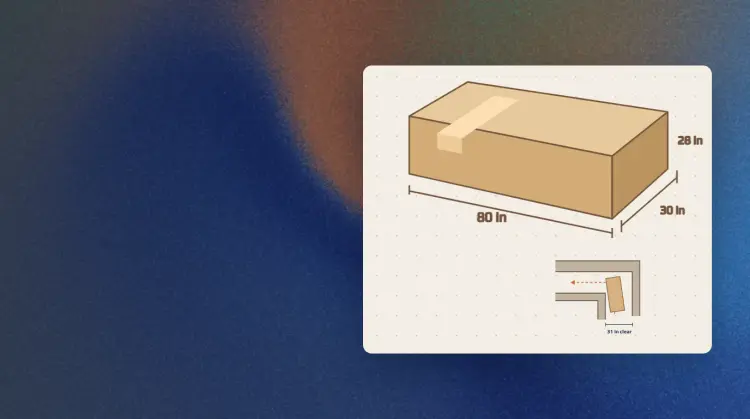
Short answer: compare the size of the carton, not the assembled sofa, with the narrowest point on the way in, and treat any tight turn as a question for a person, not a yes from a bot. With Inclamo's AI agent on the phone and in your store's web chat, the shopper gets that answer while she is still shopping, does not have to describe the sofa again when she calls, and ends with a usable next step in writing.
Today the agent works on the phone, in web chat and by email, which you connect in Inclamo Helpdesk. Messaging apps and marketplace inboxes are not agent channels, and every marketplace sets its own rules for contacting its buyers. Whether a chat carries over into a call depends on how your store's channels are connected, so confirm that for your setup.
One shopper, one sofa
Here is an illustrative case. The shopper, product and measurements are examples, not a customer's records.
Maya is looking at a two-seater sofa in oat. She asked about it in the store's web chat and saved it. She lives upstairs, so she calls the store with one question: will it get in?
Because the agent can see what she already said in the chat, she starts with her question, not with the product name and color. The store's catalog lists the sofa in one rigid carton: 80 × 30 × 28 inches. Maya has measured her front door: 31 inches clear between the door stops. Just inside, the hall turns hard left onto a landing.
On paper the carton clears the door, 30 inches deep through a 31-inch opening. The turn is a different question.
What the catalog can answer, and what only the buyer can measure
A delivery question has two halves, and they live in different places.
The store knows:
- Packed dimensions of every carton, and how many cartons the product ships in. IKEA lists this as packaging information in each product's measurements section.1 A sofa that arrives in several boxes, such as Burrow's modular seating with boxes of about 40 pounds,2 is a different delivery from one large carton.
- Whether legs or other parts come off.
- The delivery service: to the curb, to the door, or to a room, and what the crew will and will not carry.
Only the buyer knows:
- The clear width and height of every door on the route.
- Hallway width, stair width and the headroom over the stairs.
- The diagonal clearance at every turn, and the width and depth of each landing.
Furniture retailers ask for exactly these. Crate & Barrel asks shoppers to measure the diagonal depth of any hallway turn and to make sure there is room to rotate and tilt the piece.3 Room & Board asks for the width and depth of any landing, and for the distance from the stairs to the wall where a stairway ends in a wall.4 Article asks buyers to measure diagonally to check there is room to tilt or rotate the box.5
An agent can compare a published number with a number the buyer gives: a 30-inch carton depth against a 31-inch door is arithmetic. It cannot see the turn.
The exception: a tight turn right after the door
Whether an 80-inch carton can be tilted and swung through Maya's hall depends on the landing depth, the ceiling, the handrail and how the crew carries it. That is not a catalog lookup, and a confident guess is the expensive kind of wrong: it shows up as a refused delivery.
So the agent does three things:
- It tells Maya what is already clear: the carton passes her door with about an inch to spare.
- It asks for what is missing: the depth of the landing, wall to wall, and a photo of the turn.
- It does not promise a fit. It passes the case, with everything Maya has said, to the person at the store who decides on access.
This is the same rule we use for fitment in auto parts: when the data does not confirm an answer, the agent says so and hands over instead of guessing.
What Maya gets in writing
After the call, Maya has the details in the chat instead of in her memory:
- The exact variant: the two-seater in oat, the one she saved.
- The carton: one box, 80 × 30 × 28 inches.
- The delivery terms: in this example, curbside delivery with no carry upstairs, as the store's policy states.
- What is pending: the access check, and the landing depth and photo it needs.
Her decision: she waits for the access check before she books. That is a good outcome for both sides. No one guessed, no delivery is scheduled to fail, and the sale is still open.
Why this matters on the phone in particular: in a CallRail survey of 1,000 U.S. consumers published in September 2025, 78% said they had taken their business elsewhere after failing to reach a company by phone. The survey covers every industry and records what people say, not what they were seen doing.6
The merchant KPI: access-related failed deliveries
The number to watch is access-related failed deliveries: large-item orders that reach the address but cannot get to the room, counted per 100 large-item deliveries. A second, earlier signal is the share of pre-purchase delivery questions that end with a written next step.
We do not quote an industry benchmark for either. Measure your own baseline for a month, then compare after you publish carton sizes and route turn-and-stairs questions to a person.
How to set it up in your store
- Add packed dimensions and the carton count to every large product, next to the assembled size.
- Write down the delivery service levels in your shipping policy: curbside, threshold, room of choice, and what each includes.
- Decide which cases always go to a person, such as any turn straight after a door, a stairway ending in a wall, or a margin you set yourself.
- Decide what the written follow-up contains: variant, cartons, delivery terms and the open question.
Then the agent answers what your data supports and hands over the rest.
Where Inclamo fits
Inclamo is one AI agent for your store's calls and chats. It answers shoppers by phone, web chat and email, checks your Shopify store's information, and brings your team in when needed. When a shopper starts in chat and calls with a follow-up, it uses what they have already shared and asks for the missing detail. When it hands a case over, your team sees the full conversation.
Pricing is $0.49 per ticket and $0.29 per phone minute, which applies only if you use phone scenarios. No hidden fees. Inclamo is on the Shopify App Store. If your delivery rules need a scenario of their own, describe it in the scenario request form.
FAQ
Can an AI agent tell a shopper for sure that a sofa will fit?
Not when the route has a turn, stairs or a landing. It can compare published carton dimensions with the shopper's measurements. Whether a carton can be tilted through a turn needs a person who knows how it is carried.
Which dimensions should a furniture product page show for delivery?
The packed dimensions of every carton and the number of cartons, next to the assembled size. Add whether legs or other parts come off, and link the delivery service levels.
Does the shopper have to repeat the details when she calls?
Not if the chat and the call are connected in your setup. The agent uses what she already said and asks only for what is missing. Confirm the connection for your store.
Does Inclamo answer messaging apps or marketplace messages?
Today the agent works on the phone, in web chat and by email. Marketplaces set their own rules for contacting buyers, and those rules apply.
What happens when the agent cannot decide?
It says what is already clear, asks for the missing measurement or photo, and hands the case to your team with the conversation attached. You decide which cases always go to a person.
Footnotes
-
IKEA U.S., "How many boxes does my item come with and what are the weight and dimensions?", customer service article: https://www.ikea.com/us/en/customer-service/knowledge/articles/705c0805-69b1-4d80-8737-634bd30ec09b.html (accessed November 23, 2026). ↩
-
Burrow, "Delivery & Shipping": https://burrow.com/delivery (accessed November 23, 2026). ↩
-
Crate & Barrel, "How to Measure Furniture for Delivery: A Guide": https://www.crateandbarrel.com/ideas-and-advice/how-to-measure-furniture (accessed November 23, 2026). ↩
-
Room & Board, "Measuring for Furniture Delivery": https://www.roomandboard.com/customer-service/measuring-for-delivery (accessed November 23, 2026). ↩
-
Article, "Measure For Delivery": https://www.article.com/c/measure-for-delivery (accessed November 23, 2026). ↩
-
CallRail, "Why businesses can't afford to miss calls", Danielle Wood, September 25, 2025. Survey of 1,000 U.S. consumers; question wording and fieldwork dates not published: https://www.callrail.com/blog/missed-calls-cost-businesses-more-than-ever ↩
On the Shopify App Store. $0.49 per ticket · $0.29 per phone minute · No hidden fees.