
Short answer: year, make and model narrow the list, but the engine, the trim and sometimes the build month decide which part fits. A safe answer names one sellable variant from the store's own fitment data, or says it cannot confirm and hands the question to a person. With Inclamo's AI agent on the phone and in your store's web chat, the buyer gets that answer while he is still shopping, does not repeat his car's details when he calls, and ends with a usable next step in writing.
Today the agent works on the phone, in web chat and by email, which you connect in Inclamo Helpdesk. Messaging apps and marketplace inboxes are not agent channels today, and every marketplace sets its own rules for contacting its buyers. A chat and a later call share one conversation: Inclamo remembers what was said and asks only for what is missing.
One buyer, one alternator
Here is an illustrative case. The buyer, the car (the "Arden" is a made-up model) and the catalog rows are examples, not a customer's records.
Ben's battery light came on. In the store's web chat he wrote that he drives a 2018 Arden hatchback and needs an alternator. Then he calls the store to ask the real question: which one fits?
Because the call continues the chat, the agent does not ask for the year and model again. It asks for what is still missing, one question at a time:
- Engine: a 2.0-liter.
- Trim: Sport.
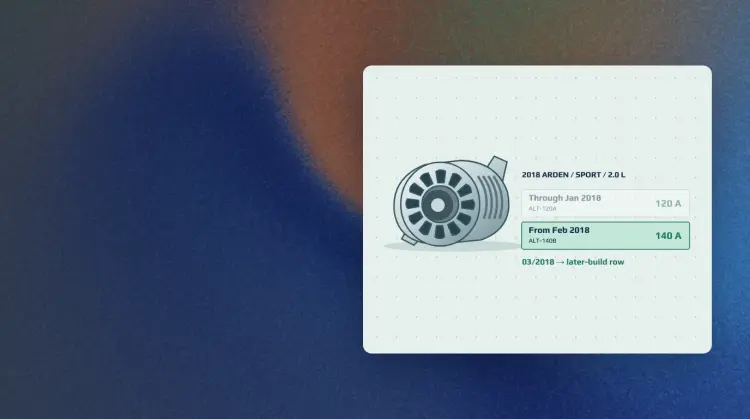
Now the catalog narrows to two alternators tagged for a 2018 Arden Sport 2.0. In photos they look almost the same.
Why year, engine and trim can still leave two parts
The two rows in this store's catalog differ by one condition:
- Built through January 2018: ALT-120A, 120 A.
- Built from February 2018: ALT-140B, 140 A.
The split is not the model year. A model year and the month a car was built are different things, and a change on the assembly line can fall in the middle of a model year. That is why parts catalogs carry conditions beyond year, make and model. The aftermarket's own data standard, ACES, uses a vehicle configuration database for vehicle configurations and attributes, and a qualifier database for the conditions that a vehicle attribute does not cover, in coded form instead of free-text notes.12
For the agent, this is the rule: a condition the data records is a question for the buyer, not a guess. It reads back the two options and asks for the build month.
Where the buyer finds the build month
Every car built for the U.S. market carries a certification label next to the driver's seat, usually on the door edge or the door-latch post. Federal rules require it to show the month and year of manufacture, such as "6/00".3
Ben walks to the car. His label reads 03/18. March 2018 falls after the split, so the matching row is ALT-140B, 140 A. The agent quotes price and availability from the store only now, after Ben has confirmed which product he means.
The exception: no build month, or no split in the data
Two things would stop the answer, and in both the agent says it cannot confirm the fit:
- Ben cannot read the label, for example because he is not at the car. The agent keeps the engine and trim he gave, explains that the build month decides between two alternators, and passes the question to the store's parts desk with the whole conversation. Within the hours the store sets, that is a transfer; otherwise a callback request.
- The store's data does not record the split. If the build-date note lives only in a product description, or the tags for the two alternators overlap, there is nothing to match against. The agent does not pick the one that sounds right. That is the same rule as in who answers the fitment call: when the tags do not confirm a fit, it says so and hands over.
Inclamo reads fitment from your vehicle tags: year, make, model, trim and drivetrain, in EasySearch tags or your own format, which we adapt the agent to. If your catalog also splits parts by engine or build date, check in the catalog scan whether the agent can match those products. Until it can, they get "can't confirm" and go to your team.
What Ben gets in writing
After the call, Ben has the answer in the chat instead of in his memory:
- The exact variant: ALT-140B, 140 A alternator.
- Why it fits: 2018 Arden hatchback, 2.0-liter, Sport, built 03/18, the row from February 2018.
- A link to that variant's product page, if your setup sends product links in chat and email replies. Confirm that for your store.
His decision: he orders ALT-140B, not the 120 A unit that also matched his year, engine and trim. Nobody guessed, and the store did not ship a part that would come back.
Why the phone matters here: in a CallRail survey of 1,000 U.S. consumers published in September 2025, 78% said they had taken their business elsewhere after failing to reach a company by phone. The survey covers every industry and records what people say, not what they were seen doing.4
The merchant KPI: fit-related returns
The number to watch is fit-related returns: orders returned because the part did not fit the vehicle, counted per 100 orders of fitment-sensitive parts. A second, earlier signal is the share of fitment questions that end with one confirmed variant instead of a handover.
We do not quote an industry benchmark for either. Tag the return reason for a month to get your own baseline, then compare after you add the missing conditions to your data.
How to set it up in your store
- Find the products that split by condition: two or more parts for the same year, make and model that differ by engine, trim, drivetrain or build date.
- Put the condition in the fitment data, not only in the description: one format across the catalog, the same way for every product.
- Make each condition its own sellable variant or product, with its own SKU and stock, so the answer points at something the buyer can order.
- Decide what always goes to a person, such as a missing build month or tags that disagree with the title.
- Run the catalog scan to see which products the agent can match and which it cannot, before any buyer calls.
Where Inclamo fits
Inclamo is one AI agent for your store's calls and chats. It answers buyers by phone, web chat and email, checks your Shopify store's information, and brings your team in when needed. When a buyer starts in chat and calls with a follow-up, it uses what he has already shared and asks for the missing detail. When it hands a case over, your team sees the full conversation.
Pricing is $0.49 per ticket and $0.29 per phone minute, which applies only if you use phone scenarios. No hidden fees. Inclamo is on the Shopify App Store. Read how the agent works for auto parts stores, or describe a scenario of your own.
FAQ
Is year, make and model enough to tell whether a part fits?
Often not. The engine, trim, drivetrain or build date can split one model year into several parts. If the store's data records the split, the agent asks the buyer for it. If not, it says it cannot confirm the fit.
Where does a buyer find his car's build date?
On the certification label next to the driver's seat, usually on the door edge or the door-latch post. It shows the month and year of manufacture.
Does the buyer have to repeat his car's details when he calls?
No. A chat and a later call share one conversation. The agent uses what he already said and asks only for what is missing.
Can the agent look up a part by VIN?
Not by voice. It can look up a part number the buyer reads out, but it works best from year, make, model, trim and drivetrain in your tags.
What happens when the agent cannot confirm the fit?
It explains what is still unknown and hands the question to your team with the conversation attached: a transfer within your hours, otherwise a callback request.
Does Inclamo answer messaging apps or marketplace messages?
Today the agent works on the phone, in web chat and by email. Marketplaces set their own rules for contacting buyers, and those rules apply.
Footnotes
-
Auto Care Association, "Vehicle Configuration database (VCdb)", part of the Aftermarket Catalog Exchange Standard (ACES): https://www.autocare.org/data-and-information/data-standards/databases/vehicle-configuration-database-vcdb (accessed November 25, 2026). ↩
-
Auto Care Association, "Qualifier database (Qdb)": https://www.autocare.org/data-and-information/data-standards/databases/qualifier-database-qdb (accessed November 25, 2026). ↩
-
49 CFR § 567.4, "Requirements for manufacturers of motor vehicles", paragraphs (c) and (g)(2), eCFR: https://www.ecfr.gov/current/title-49/subtitle-B/chapter-V/part-567/section-567.4 (accessed November 25, 2026). ↩
-
CallRail, "Why businesses can't afford to miss calls", Danielle Wood, September 25, 2025. Survey of 1,000 U.S. consumers; question wording and fieldwork dates not published: https://www.callrail.com/blog/missed-calls-cost-businesses-more-than-ever ↩
On the Shopify App Store. $0.49 per ticket · $0.29 per phone minute · No hidden fees.